Hart
House in Essex, Massachusetts
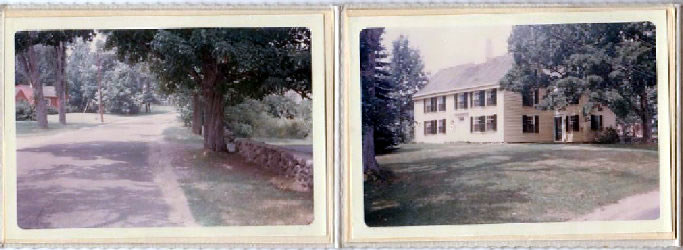
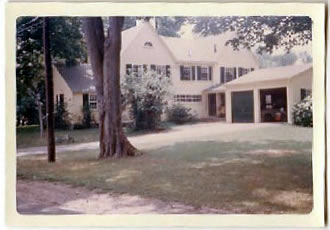
(See the picture above of George & Bessie's house. Their
three daughters are in the buggy)
George Albert Hart (1864-1938) wife Bessie (1869-1951) and
their three children Grace (1897-1969), Dorothy (1900-1993)
and Mary (1908-1978) lived in this small town of Essex, Massachusetts.
It was a peaceful place, a little town on the Essex River,
not far from the famous old port of Gloucester. Everybody
knew everybody else in Essex and everybody else's business.
I remember when we got our telephone. If someone called you
and you didn't answer, the telephone operator usually knew
where you had gone and when you would return, and she would
relate this information to the person who had phoned you.
We lived in the last house at the end of a dead end street.
Besides the house, there were two storage buildings that my
father used in his provision business and a small barn, which
housed a horse and a carriage, called a Democrat. Later it
was used as a garage, although garden tools and odds and ends
could be found there also. All these structures were connected
to the house by a porch-like covered walkway.
The street was called Spring Street because, at the corner,
there was a clear spring of water where townspeople came with
jugs and pails to get drinking water. There was no "town
water" yet and pump water was usually hard, had a rusty
taste, and wasn't safe to drink anyway. It was cool by the
spring - cool and wet - and willow-shaded. The door to it
was slanted, like a bulkhead door, and screened so that leaves
and debris would not sully the water. When you opened the
door, you would always hear "splash, splash" as
one frog after another jumped off the brick ledge into the
water.
Then there was the trip home with the cool pail bumping your
leg, and occasional splashes of water drenching your hot skin.
We made lemonade with it and strawberry-aide (with crushed
wild berries, sweeter than sugar, with the tang of hot sun
in them). In the winter we went for water only on special
occasions when there was City Company who might expect it
on the table. Thanksgiving and Christmas we went to the spring
for water. Otherwise we drank cocoa or tea or coffee, all
made with boiled water from the well, pump water. I guess
I never liked plain water, and I still don't. Maybe it was
because of those frogs!
To get to town was a long way by the road. But we had a short
cut. We called it "going across the fields." In
front of our house was a large field that had a small hill
in it. It was an apple orchard and hay field combined and
it opened directly into our lane. On the other side of the
road, at the base of Cap'n Sam's Hill, was the shipyard where
wooden ships were built. It belonged to Arthur Dana Storey
at that time. This was a wonderful and fascinated place. Long
planks were piled high and where one protruded beyond his
fellows, it became a springboard where we could bounce up
and down endlessly.
From our house we could always hear the pounding and hammering
as a boat was under construction. These were fishing boats
that would, when completed, be launched into the Essex River
and then go down to Gloucester to have the masts steeped and
the rigging put on. A launching was always attended by many
townspeople.
Contributed by Mary (Hart) Pletsch